.png)
Tree Removal in Elkhart, South Bend, and LaGrange: What You Need to Know

Whether you're dealing with a dying tree, storm damage, or a tree that's simply too close to your home, there are times when tree removal becomes necessary. At Dogwood Hills Tree Farm, we offer professional tree removal services throughout Elkhart County, St. Joseph County, LaGrange County, Kosciusko County, and beyond—including cities and towns like Elkhart, Goshen, Middlebury, Bristol, South Bend, Mishawaka, Granger, LaGrange, Syracuse, and Shipshewana,.
If you're wondering when it’s time to remove a tree or what the process involves, here’s what you should know.
When Should a Tree Be Removed?
Tree removal isn't always the first option, but in some cases, it's the safest and most responsible choice. Here are some of the most common signs it might be time to take a tree down:
The tree is dead or dying. If your tree has stopped producing leaves, has large areas of deadwood, or shows no signs of new growth, it may be past saving. Dead trees are more likely to fall during storms, posing serious risks to your property and loved ones.
It’s leaning dangerously toward a structure or walkway. A leaning tree may indicate root instability or structural weakness. If it’s leaning toward your home, garage, driveway, or a frequently used sidewalk, it should be evaluated by a professional right away.
There are signs of internal rot, fungus, or pest infestation. Mushrooms growing near the base, hollow sections in the trunk, the presence of carpenter ants, or an increase in woodpecker activity can all point to internal decay. Trees in this condition are unpredictable and can become hazardous quickly.
It was damaged in a storm. High winds, ice, and lightning can all break branches or weaken a tree’s structure. If your tree has large broken limbs, split trunks, or exposed roots after a storm, removal may be the safest solution.
It’s interfering with structures or utilities. Trees planted too close to houses, power lines, septic systems, or driveways can cause serious damage over time. Roots may crack foundations or pavement, and branches can threaten roofs or power lines. In these cases, removal prevents future problems.
What’s Involved in the Tree Removal Process?
Many homeowners are surprised to learn that tree removal is more complex than simply cutting down the tree. At Dogwood Hills, we take a careful, professional approach to ensure safety and efficiency.
Site Evaluation: We assess the tree’s condition, surrounding structures, and terrain to determine the best strategy for removal. Safety—for both people and property—is our top priority.
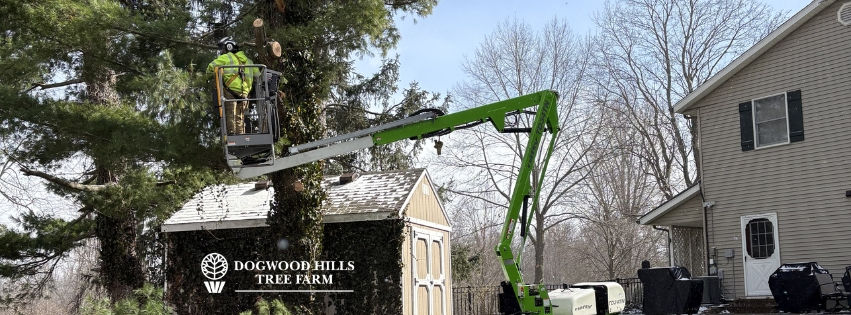
Determination of Appropriate Equipment: We have a 75’ bucket truck, a low impact spider lift, tree climbers, and access to cranes which allows us to safely and efficiently remove your tree. Based on the size and location of your tree, we will determine the ideal equipment to complete your project to avoid damaging your home, fence, or landscaping.
Debris Cleanup and Wood Disposal: After removal, we clean up all debris. We can haul everything away or, if you prefer, cut the wood into manageable logs for firewood.
Stump Grinding (Optional): If you want a clean, level yard, we offer stump grinding services to remove the base of the tree entirely. This also helps prevent new growth and keeps pests away.
Trusted Tree Removal in Northern Indiana
As a family-owned tree farm with deep roots in the community, Dogwood Hills brings local knowledge, professional equipment, and years of experience to every job. Whether you're in a residential neighborhood in South Bend, a rural area near Shipshewana, or anywhere in between, we’re ready to help with prompt and reliable service.
Get a Free Estimate Today
If you have a tree that looks questionable—or you just want peace of mind—contact us today for a free, no-pressure estimate. Our experienced team will assess the situation and walk you through your options, including removal, trimming, or transplanting if applicable.
Let Dogwood Hills Tree Farm take care of your tree problems—so you can enjoy a safer, cleaner, and more beautiful outdoor space.


Comments